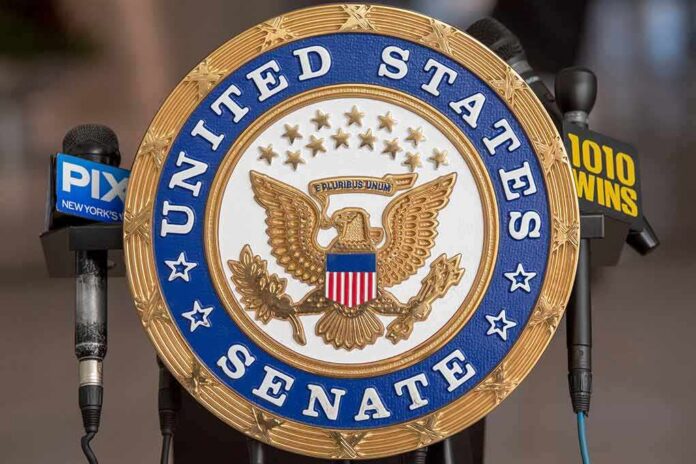
With hours left before a shutdown, Senate Democratic Leader Chuck Schumer said he would back a Republican stopgap bill to keep the government open, triggering an immediate revolt from parts of his own party.
Story Highlights
- Schumer said he would vote to advance a Republican funding bill to avert a shutdown.
- The Senate then passed the stopgap, with some Democrats joining Republicans to move it forward.
- Progressive Democrats blasted Schumer, calling the bill a “dangerous” surrender.
- The fight reflects a pattern: short-term fixes have replaced normal budgeting for years.
Schumer’s Decision Broke The Logjam And Split Democrats
On the eve of a funding deadline, Senate Democratic Leader Chuck Schumer said he would vote to keep the government open by advancing a House-passed Republican stopgap bill. His move cleared a path for enough Democrats to cross the aisle and end a potential shutdown threat. Schumer said avoiding a shutdown outweighed his concerns with the bill’s contents, which Republicans wrote to extend funding for months while talks continue.
The Senate then passed the stopgap, preventing an immediate halt to many federal services. Reports described a close, hard-fought series of votes that required Democrats to help the measure advance despite strong opposition within their ranks. The bill headed to President Trump for his signature, with backers saying the vote kept paychecks flowing and agencies working while Congress negotiates the larger budget fight.
Progressive Blowback Cast The Vote As A Surrender
Progressive lawmakers and activists condemned the decision. Senator Bernie Sanders said “nobody” should have backed the bill, calling it “dangerous” and a “dereliction of duty.” He argued the plan shifted power away from Congress on spending choices and warned it favored elites over working families. House Democrats also signaled they preferred a shorter, four-week bill and criticized Schumer for reversing after earlier resistance to the House plan.
Some House Democratic leaders framed the vote as breaking from the party’s stance and message. They said their caucus stood with the public against what they viewed as an unacceptable tradeoff. The swift backlash underscored a deeper split over tactics: accept a stopgap to protect basic services now, or hold out for a shorter bill to keep pressure on talks. That debate turned personal as senior Democrats expressed disappointment with Schumer’s call.
A Shutdown Averted, But The Governing Cycle Remains Broken
The outcome fits a familiar pattern in Washington. When deadlines loom, Congress often turns to “continuing resolutions,” which extend last year’s funding levels for months at a time. The Government Accountability Office reports that in most years since the late 1990s, lawmakers have needed these stopgaps to avoid lapses in services. Short-term bills have become the default, not the exception, complicating planning for agencies and the economy.
Omnibus Spending Bills & Continuing Resolutions in which Schumer allowed a controlled block of moderate Senate Democrats to cross party lines and vote with Republicans to approve stopgap funding bills without pushing Democratic policy riders such as restricting ICE. DHS and ICE…
— Fia (@Fiaaavery) August 24, 2026
Both right and left see the same warning sign: government by crisis is now routine. Conservatives blame years of overspending and a broken budget process. Liberals see leverage handed to powerful interests while core programs drift. Voters across the spectrum watch leaders kick the can, and trust sinks further. This latest showdown ended without a shutdown. But it did not fix the system that keeps producing them, and it did not settle the fight over what gets funded, and for how long.
Why This Matters For Families And Main Street
Shutdowns hit paychecks, small businesses, and local services. Air travel slows. Research labs pause. Benefit processing can lag. A stopgap avoids those shocks, but it also freezes plans and delays choices that could lower costs or improve services. Agencies cannot start new projects or hire with confidence. That uncertainty feeds public anger toward Washington and confirms the fear that leaders protect their jobs first and solve problems later.
What Comes Next In Congress
Lawmakers now face a long road to pass the full set of annual spending bills. Republicans control the House and Senate, and President Trump is set to sign the stopgap. Democrats will push for changes they say protect workers and key programs. Republicans will argue their plan keeps spending in check. If talks stall, another deadline will return, and the same high-stakes cycle could repeat unless both sides agree to set clear priorities and stick to a schedule.
Accountability Test: Can Washington Break The Cycle?
Congress can still restore regular order by writing and passing the twelve full-year bills on time. That would give agencies certainty and allow real oversight. It would also show voters that elected officials can put service over standoffs. For now, the stopgap is a short victory against disruption. The larger test is whether leaders will do the harder work to end crisis budgeting and rebuild trust, rather than asking the country to accept yet another patch.
Sources:
cbsnews.com, yahoo.com, reuters.com, spokesman.com, nytimes.com, thehill.com, congress.gov