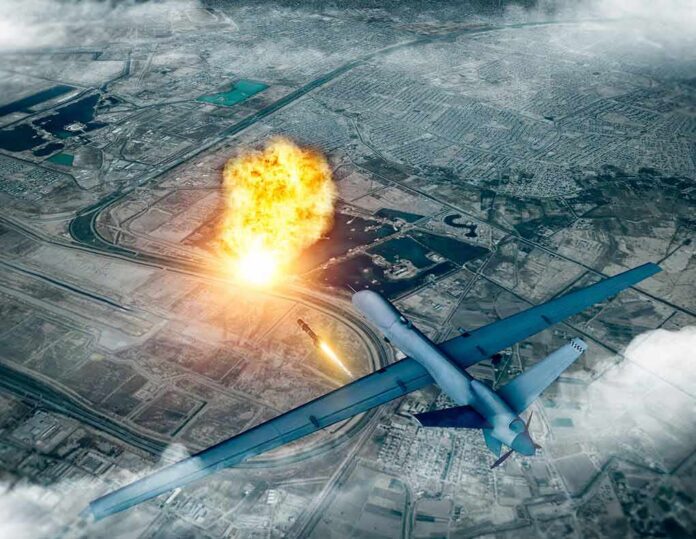
Iran fired ballistic missiles at the largest American military base in the Middle East, and Qatar confirms one of them slipped past air defenses and hit the base.
Quick Take
- Iran struck Al Udeid Air Base in Qatar after U.S. strikes hit its nuclear facilities.
- Qatar says one missile was intercepted while a second one reached the base, causing no casualties.
- U.S. officials say no American troops were killed or hurt in the attack.
- Iranian state media claims the strike destroyed radar and refueling aircraft, but no U.S. or independent report confirms that.
- Reports disagree on how many missiles Iran actually launched, ranging from two to nineteen.
Iran Says Attack Was Payback For Nuclear Strikes
Iran’s Islamic Revolutionary Guard Corps said its forces launched the strike as direct payback for U.S. attacks on Iran’s nuclear program. State-linked statements described the operation as self-defense and said Iran fired “one missile for each U.S. bomb” dropped on its nuclear sites. Iranian officials called the mission “destructive and powerful,” framing it as a calculated response rather than a surprise first move.
The target was Al Udeid Air Base near Doha, which multiple news outlets identify as the largest U.S. military installation in the Middle East and the forward headquarters for U.S. Central Command. That status made the base a high-visibility target, since a strike there sends a political message even beyond any physical damage it causes.
Qatar Confirms One Missile Got Through
Qatar’s Defense Ministry said Iran fired two missiles at the base. Air defenses intercepted one, but the second missile reached Al Udeid without causing any casualties. That account has been repeated across multiple outlets, making the basic fact of a successful hit one of the more solid pieces of this story, even as bigger damage claims remain unproven.
Two U.S. officials told reporters that no American personnel were killed or injured in the attack. That detail matters because it shows Washington and Doha are not disputing that a missile landed on the base. Instead, officials are focused on downplaying the human and operational cost of the strike.
Damage Claims Split Sharply Along Political Lines
Iranian state media and IRGC-aligned outlets claim the strike destroyed a radar system and a strategic aerial refueling aircraft. Some social media accounts and video reports go further, describing scorched ground and damaged buildings near maintenance areas. None of these specific claims come with a confirmed U.S. military damage report, leaving them unverified rather than disproven.
No declassified battle-damage assessment, Pentagon statement, or independent satellite analysis in the public record confirms destroyed equipment at the base. That gap leaves a wide space between Iran’s claims of major destruction and Qatar’s message of “no casualties,” with the real scope of physical damage still unclear to the public.
🚨Defense Intelligence Report – Post 1/2
Russian Intelligence Enabling Iranian Attacks on CIA and DoW Facilities
We judge with high confidence that Russia is actively supplying Iran with satellite-derived location data and imagery of U.S. military bases, naval/air assets, and… pic.twitter.com/0b9mGrxabs
— Tal Shiar Directorate of Intelligence (@Tal_Shiar_DI) July 28, 2026
Reports also disagree on basic numbers. Different outlets say Iran launched anywhere from two to nineteen missiles, with estimates on how many actually reached the base ranging from zero to six. That kind of inconsistency makes it hard for anyone, including lawmakers and the public, to get a clear picture of exactly what happened that night.
Why The Fog Around This Strike Matters
This kind of confusion is common after modern missile attacks on military bases. Official statements and state media usually reach the public long before independent evidence like satellite images or debris analysis does. That gap lets each side control its own version of events, at least until outside proof catches up, if it ever does.
For Americans watching from home, the bigger worry isn’t just what happened at one base in Qatar. It’s whether the public will ever get a straight, verified answer, or whether this becomes another incident where officials on all sides manage the message instead of releasing the facts. Trust in that process matters more than any single missile count.
Sources:
thegatewaypundit.com, bbc.com, timesofisrael.com, youtube.com