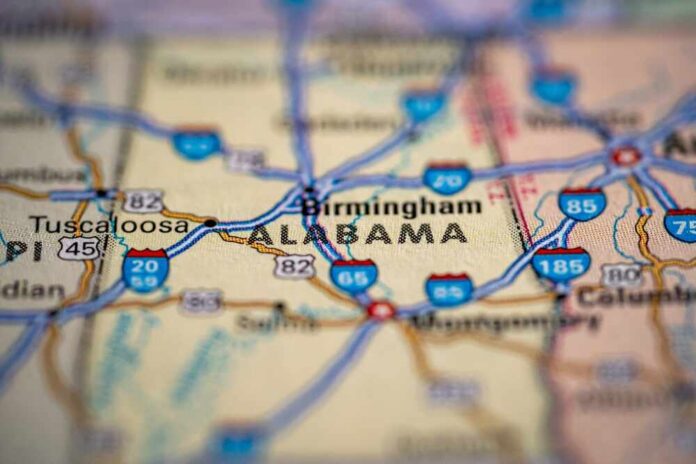
The U.S. Supreme Court has handed Alabama Republicans a significant win, greenlighting a new congressional map that eliminates one of two majority-Black districts — and Democrats, civil rights groups, and out-of-state activists are flooding the streets of Montgomery to fight it.
Story Snapshot
- The Supreme Court cleared Alabama to use a new congressional map that will likely remove a Democratic incumbent and reduce majority-Black districts from two to one.
- Alabama held a special legislative session to pass House Bill 1 (HB1), a procedural measure allowing a special primary if federal courts alter maps too late for the normal election schedule.
- Republican lawmakers argue the courts themselves prohibit racial gerrymandering and that HB1 is a legal, process-oriented response to federal court uncertainty — not an effort to disenfranchise anyone.
- Activists and Democratic lawmakers framed the protests as a continuation of the Civil Rights Movement, drawing comparisons to Selma and invoking the 1965 Voting Rights Act.
Supreme Court Clears Alabama’s New Map
The Supreme Court gave Alabama the go-ahead to move forward with a congressional map that will likely eliminate one of the two majority-Black congressional districts the state had operated under since court-ordered redistricting took effect for the 2024 elections. [8] That earlier court-drawn map had been imposed after the Supreme Court’s 2023 ruling in Allen v. Milligan found Alabama’s prior map likely violated the 1965 Voting Rights Act by diluting Black voting power. [3] The new Supreme Court action effectively reverses course, allowing the state-drawn configuration to govern future elections. [7]
Alabama Attorney General Steve Marshall welcomed the development, noting that the state had long objected to what he called a racially gerrymandered, court-drawn map that had been imposed on Alabama for the 2024 cycle. [9] The legislature had passed its own remedial map, and the Supreme Court’s latest action validates the state’s position that elected representatives — not federal judges — should draw district lines. [9]
Special Session and the HB1 Debate
Alabama lawmakers convened a special legislative session centered on House Bill 1, which would authorize a special primary election if federal courts change congressional or state senate maps too late for the normal election schedule to accommodate. [6] Republican Representative Danny Garrett defended the bill, arguing that courts prohibit racial gerrymandering and that the legislation is not designed to disenfranchise Black voters. [6] He framed HB1 as a procedural safeguard against judicial timing disruptions, not a substantive attack on minority representation.
Under the legal posture at the time of the session, Alabama lawmakers could not unilaterally redraw maps again until after the 2030 census unless the Supreme Court granted an emergency request. [6] That constraint means HB1 operated within a narrow procedural lane — managing election scheduling contingencies rather than redrawing district lines outright. Critics who described it as a sweeping attack on Black voting power did not engage directly with that legal limitation in the available record. [6]
Protests Draw Crowds — and Outside Organizers
Demonstrations filled the Alabama State Capitol grounds as activists chanted civil-rights-era songs and Democratic lawmakers joined the rallies. State Representative Merika Coleman called HB1 “a strategic attempt to dilute the voices and votes of African Americans by spreading them out so thin that their voices don’t matter anymore.” [3] Democratic Senator Cheyanne Webb-Crisberg declared that “civil rights is never secured permanently,” framing the legislative fight as an ongoing generational struggle. [3]
Thousands descended on Alabama Saturday for the “All Roads Lead To The South” rally, demanding protection for Black voting power as Southern states prepare for redistricting battles ahead of the 2026 midterms.
Read more #OnTheGrio: https://t.co/Bblgfd4geN
— theGrio.com (@theGrio) May 17, 2026
Organizers described the Alabama action as part of a broader Southern “Summer of Action” spanning Texas, Mississippi, and Alabama — a coordinated multi-state campaign targeting redistricting fights across the region. [1] While the passion of protesters is genuine, the evidentiary case against HB1 rested heavily on activist speeches and rally footage rather than demographic analyses, district maps, or direct evidence of discriminatory legislative intent. [2] The Supreme Court’s decision to allow Alabama’s map to proceed suggests the legal landscape is shifting — and that the loudest voices in the streets do not necessarily reflect where the law currently stands. [7][8]
Sources:
[1] Web – Demonstrations to sweep the South over voting rights and redistricting
[2] YouTube – Voters protest SCOTUS voting rights ruling at Alabama capitol
[3] YouTube – Dem Senator joins protesters in Alabama to fight for voting rights
[6] Web – Alabama Arise slams GOP-led redistricting effort following …
[7] YouTube – Roads Lead to the South: National Day of Action for Voting …
[8] YouTube – People protest against redistricting at the Special …
[9] YouTube – Redistricting fight escalates after Supreme Court ruling