When an American president defends taking political “dirt” from foreign powers while network editors quietly slice key parts of his interviews, it feeds the fear that both our elections and our news are being gamed from above.
Story Snapshot
- Trump’s latest clash with NBC over “rigged” elections revives an older fight about foreign-sourced political dirt and what counts as normal opposition research.
- Past comments show Trump saying there is “nothing wrong with listening” if a foreign government offers damaging information on a rival, raising legal and ethical alarms.[16]
- Critics warn that treating foreign help as routine politics blurs the line between legal influence and illegal interference in U.S. elections.[17][20]
- Heavy editing of Trump interviews by big networks has angered both supporters and critics, deepening distrust of media “gatekeepers” on all sides.[14]
Trump’s ‘banned’ interview and the pattern of media blowups
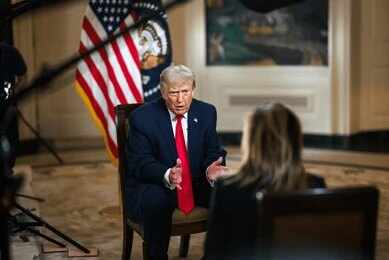
NBC’s recent “Meet the Press” sit‑down with President Donald Trump followed a script many Americans now recognize. Trump made sweeping claims about a “rigged” 2020 election and problems in California’s primaries, but offered no proof when pressed.[1][12][13] Moderator Kristen Welker challenged him, saying what he presented was not evidence.[1][12] After repeated pushback, Trump grew angry, ripped off his microphone, called NBC “crooked,” and walked out before the full hour was done.[2][3][9][12][13]
NBC later aired an edited version and published fact‑checks showing no evidence for his fraud claims, no proof of Federal Bureau of Investigation (FBI) agents escorting people into the Capitol on January 6, and no confirmed problems with California’s vote counting.[1] For Trump’s backers, the dramatic walkout looked like a president fighting a biased press that never accepted his America First agenda. For his critics, it looked like one more attempt to dodge accountability on an issue that strikes at the core of democracy: whether votes still count.
Foreign “oppo” research: normal politics or a threat to sovereignty?
Trump’s defenders frame these clashes as part of a bigger debate over “opposition research.” In both parties, campaigns have long dug up damaging facts on rivals using public records and private tips.[21][22] From this view, Trump’s openness to information from abroad is just a blunt version of what everyone does, and the real scandal is a system where elites and their media allies decide which stories voters may see. Many Americans, right and left, hear “foreign dirt” and shrug, believing political insiders already play dirty while regular people struggle with inflation, immigration chaos, and high energy costs.
Critics see something very different. In a 2019 ABC interview, Trump said that if a foreign country called with information on an opponent, “I think I’d want to hear it,” adding there was “nothing wrong with listening.”[16][17] Election‑law experts pointed to long‑standing bans on foreign contributions, warning that opposition research can be a “thing of value” under federal law.[16] They argued that welcoming secret help from foreign governments invites more covert pressure, blackmail, and propaganda, all aimed at bending U.S. elections from the outside.[16][17][20] For these critics, the problem is not opposition research itself but who is supplying it and what they expect in return.
Foreign influence, foreign interference, and a weakened watchdog
Legal scholars and democracy groups now stress a key distinction between “foreign influence” and “foreign interference.” Foreign influence covers a wide range of actions, such as propaganda, social media messaging, or lobbying, many of which fall into a gray area under free‑speech rules.[20] Foreign interference, by contrast, includes hacking voting systems, funding campaigns, or secretly directing operations to sway outcomes, and is generally illegal under several federal laws.[20] Russia’s 2016 hacking of election systems is the only confirmed act of direct interference so far.[20]
Reports say that Russia, Iran, and China have continued to run influence efforts in later elections, even as experts found no proof of foreign interference in the 2020 or 2024 federal contests.[20] At the same time, the second Trump administration has dismantled the specialized offices that once focused on tracking and blocking foreign influence campaigns, leaving states and local officials with fewer federal tools to detect covert meddling.[20][18] For many Americans, this looks like a dangerous gap: leaders in Washington fight each other on television about “rigged” elections, yet the basic guardrails against foreign pressure quietly weaken in the background.
Media editing fights and the deepening distrust of elites
The uproar over NBC’s handling of the Trump interview taps into a wider anger at media gatekeeping. In 2025, a CBS “60 Minutes” interview with Trump sparked backlash after the broadcast cut key sections about his 2020 “rigged and stolen” claims, his lawsuit against the network, and his push to show falling crime in Washington, D.C.[14][2] CBS later released a longer, 73‑minute version online, but critics on both the right and the left saw the initial edit as proof that powerful outlets shape what the public is allowed to hear.[14]
Breaking News | 🇮🇹 Italy Cancels US Visit After Trump Remarks on PM Meloni
➡️ Italy's Foreign Minister Antonio Tajani has canceled a planned visit to the United States following remarks by US President Donald Trump about Italian Prime Minister Giorgia Meloni.
🔹 According to… pic.twitter.com/roWtSKiWXi
— Nigerian Trump🇮🇱🇳🇬🇱🇷🇿🇦🇬🇧 (@Amblojiggy) June 19, 2026
Trump and his allies argue these cuts are part of a pattern: big media companies and coastal elites act as unelected censors, filtering populist voices while protecting their own influence. Many liberals, meanwhile, worry that incomplete or overly polished interviews let presidents dodge real scrutiny on wars, corporate power, and corruption. Both sides end up in the same place emotionally, even if they blame different villains: they believe someone else is pulling the strings, and that the truth about foreign deals, election security, and money in politics is being hidden.
Why this fight matters beyond Trump
The clash over Trump’s “banned” interview is not just about one president’s temper or one network’s edit. It sits at the crossroads of several deeper problems: rising partisan hatred, a foreign policy run more from the Oval Office than from Congress, and a political class that treats information as a weapon instead of a public good.[18] Scholars find that as polarization grows, lawmakers pass fewer foreign‑policy laws and hand more power to the president, who can then make big moves abroad with less oversight.[18][19]
When a president signals that foreign‑sourced dirt is just another tool, and when major networks slice and package his words, many citizens on both sides see the same warning sign. They worry that the people at the top—politicians, media bosses, donor classes, and security insiders—are playing a game among themselves while ordinary Americans carry the cost in unstable elections, endless investigations, and wars they never voted for. The core question is no longer about one interview. It is whether the system still serves the public, or only the permanent class that runs it.
Sources:
[1] Web – Here’s The ‘Banned’ Trump Interview Sparking International Brawl — And …
[2] Web – Fact-checking Trump’s interview with NBC News’ ‘Meet the Press’
[3] Web – Trump abruptly ends ‘Meet the Press’ Interview over fact-check dispute
[9] X – Even more disturbing, damning evidence that Donald Trump …
[12] Web – Tamara Keith and Amy Walter on Trump’s walkout from NBC interview
[13] Web – Trump abruptly ends NBC interview after clash over ‘rigged election’ …
[14] Web – Donald Trump abruptly ended a sit-down interview …
[17] Web – Trump Willing to Accept Research on His Political Opponents From …
[18] Web – Why Trump’s view of accepting foreign opposition research is … – PBS
[19] Web – Polarization and US foreign policy: key debates and new findings
[20] Web – RESEARCH | Rachel Myrick | Political Science | Duke University | USA
[21] Web – Foreign Influence vs. Foreign Interference in Elections
[22] YouTube – America In The Trump ERA: Opposition Research By The RNC